

Quick Facts: Data Centers in Ohio
 What is a Data Center?
A data center is a large building filled with computer servers and related equipment. These computers store, process and move information that supports everyday services like cloud storage, streaming videos, apps, websites, artificial intelligence (AI) and online business operations.
Data centers are extremely energy- and water- intensive. Before they can operate, they may require major investments in infrastructure, including upgrades to electric transmission lines and substations to handle their large electricity needs.
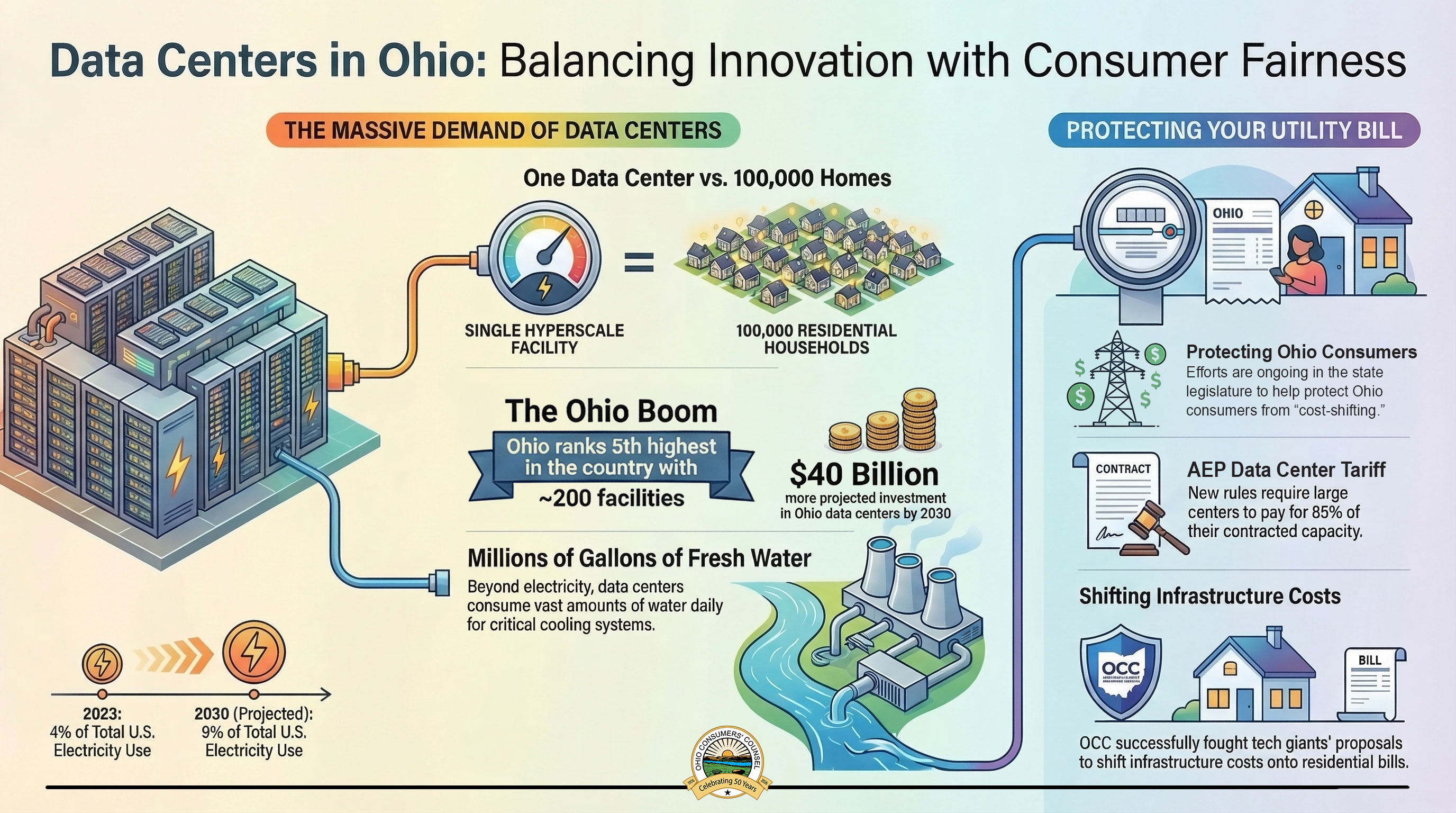
A large or “hyperscale” data center can use as much electricity as 100,000 homes. In 2023, data centers nationwide used 176 terawatt-hours (TWh) of electricity, roughly 4% of all U.S. electricity used that year. That share is expected to grow to 9% by 2030. To put that in perspective, 176 TWh is roughly equal to the total amount of electricity used by the entire state of Ohio in 2023.
Data Centers in Ohio
Ohio has more than 200 data centers, making it the fifth-highest state in the country. Most are in Central Ohio, where land availability, transmission access, and proximity to consumers make development attractive.
Jobs and Investment
- Companies plan to invest up to $40 billion more in Ohio data centers by 2030.
- While construction creates short-term jobs, data centers create relatively few permanent jobs once they are built.
Power, Land, and Water Use
- Data centers require large amounts of electricity to run computer equipment.
- Electricity and water are both used for cooling systems to prevent servers from overheating.
- Some data centers use millions of gallons of fresh water per day for cooling.
- Large, AI-focused “hyperscale” data centers can consume as much energy as small cities.
Energy Demand and Consumer Impact
- The rapid growth of data centers is driving higher electricity demand nationwide, which can put upward pressure on prices for residential consumers.
- In June 2025, many Ohio consumers saw electric supply price increases of 10% to 35%.
- Connecting data centers to the grid may require new or upgraded transmission infrastructure, costs that have historically been shared by all consumers.
The Office of the Ohio Consumers’ Counsel (OCC) is also closely monitoring distribution costs, the local system that delivers electricity from substations to homes and businesses, which may rise as data center demand grows.
OCC Consumer Advocacy
- The Public Utilities Commission of Ohio (PUCO) approved AEP Ohio’s Data Center Tariff which requires new, large data centers to pay for at least 85% of their contracted electricity capacity for up to 12 years, even if they use less.
- Thanks in part to consumer engagement, the PUCO approved a settlement in AEP Ohio’s data center case, Case No. 24-508-EL-ATA. The settlement is designed to protect consumers from bearing the high infrastructure costs caused by data centers.
- OCC was party to the settlement, along with AEP, PUCO Staff, Ohio Partners for Affordable Energy, and others. The agreement created a first-of-its-kind tariff that helps ensure data centers pay for infrastructure they require.
- Large technology companies including Amazon, Google, Microsoft, and Meta (Facebook) opposed the settlement and proposed an alternative that would have shifted more costs onto residential consumers’ electric bills.
OCC’s Ongoing Role
OCC will continue advocating for affordability and fairness as data centers expand across Ohio. Our goal is to reduce financial risk for residential consumers and ensure that data centers are responsible for the energy they use and for the infrastructure upgrades needed to power their facilities.
What You Can Do
Consumers with concerns or questions regarding current or proposed data centers in their area can contact their local elected officials, city council members, township trustees, county commissioners, or other local government officials who make decisions about property use, tax abatements, and data center regulations.
State and federal regulations are also currently being considered. Consumers are encouraged to reach out to their state and national elected officials to express their concerns. To identify who represents your area on the state and national levels and find tips on contacting them, visit https://www.occ.ohio.gov/advocacy#legislator.
To download: Click the folder with a down arrow icon. To print: Click the printer icon in the top right of the display.
If you need multiple copies for an organization or group, please contact a member of our outreach team.